

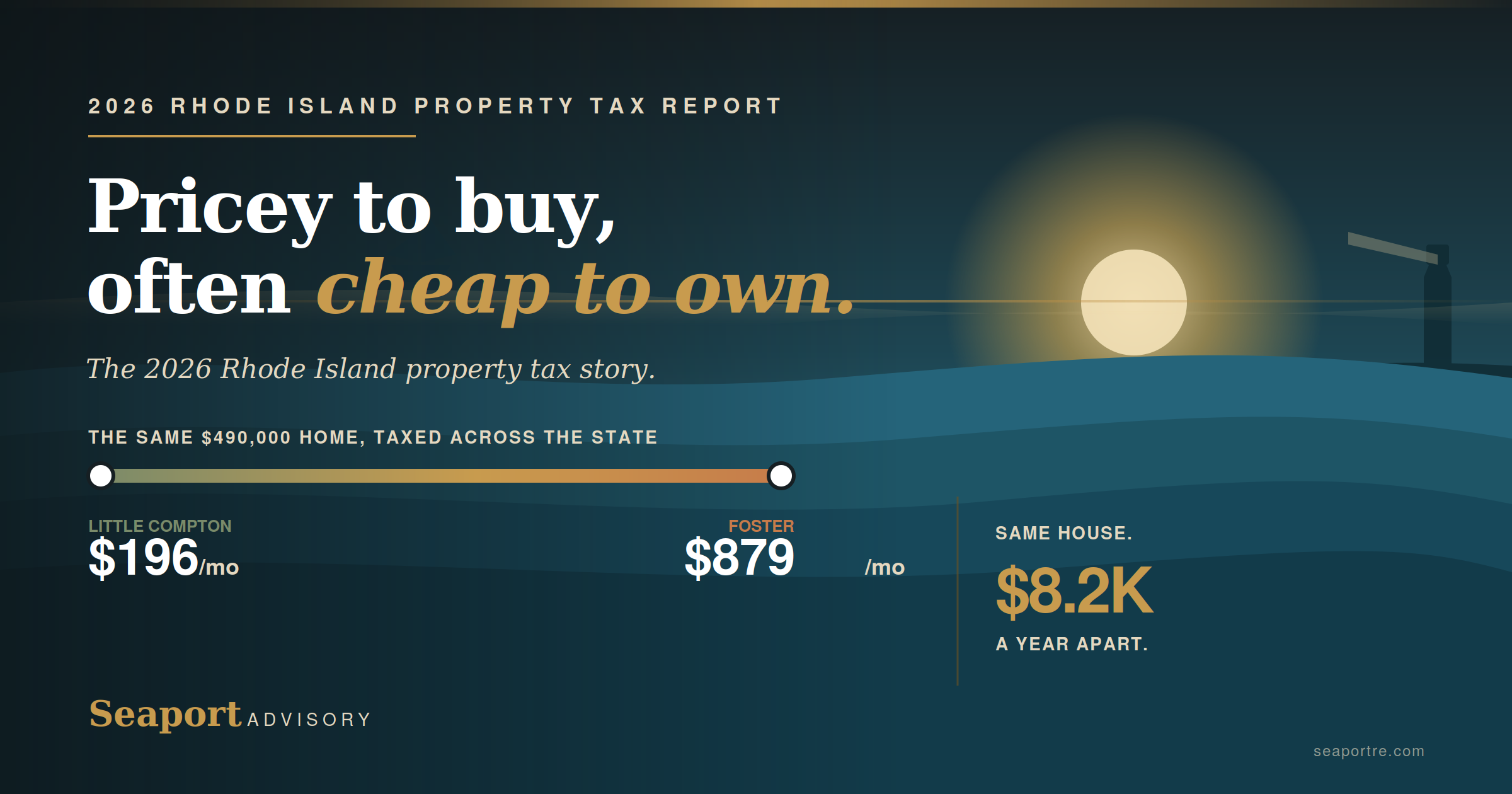
The list price tells you what a home costs to buy. It says nothing about what it costs to own— and in Rhode Island, that second number swings hard from one town to the next. The same home can cost three times as much to hold depending on which side of a town line it sits on.
| $4.79
Lowest rate
(Little Compton) |
$21.52
Highest rate
(Foster) |
$12.70
Statewide
median |
39
Cities & towns
in this report |
The number most buyers never check
Everyone shopping for a home watches the price. Far fewer ask the question that actually sets the monthly payment: what’s the property tax? In Rhode Island, that answer comes from your town’s tax rate — the dollars charged per $1,000 of assessed value — and it varies enormously across the state’s 39 cities and towns.
Rhode Island keeps the math relatively clean: the state assesses property at roughly 100% of market value(unlike neighboring Connecticut, which uses 70%), then applies the local rate. So a $400,000 home taxed at $12 per $1,000 owes about $4,800 a year. But with rates running from under $5 to over $21, the same house can be affordable to own in one town and a genuine stretch in the next.
The same $490,000 home, taxed across Rhode Island
Take one home priced at $490,000 — right around the statewide median — and drop it into each town without changing anything else. The tax bill is a different animal in every one.
Over a ten-year hold, that gap alone is the difference between about $24,000 and $105,000 handed to the tax collector — on identical houses. It’s the single biggest reason we tell buyers to underwrite the tax before they fall for the price.
The coastal paradox: pricey to buy, cheap to hold
Here’s where Rhode Island gets counterintuitive. You’d assume the priciest towns would cost the most to own. On the shoreline, the opposite is true — and dramatically so.
Measured as a share of what a home actually sells for — the true effective tax rate— the six lightest-to-hold towns in Rhode Island are all coastal: Little Compton, Jamestown, Block Island, Charlestown, Narragansett, and Westerly, every one under 0.75%. Several have median prices well over $1 million. Block Island’s median sits around $2 million, yet it’s the third-cheapest town in the state to hold, dollar for dollar. Meanwhile inland towns like Foster and Providence carry effective rates two to four times higher on far less expensive homes.
In plain terms: on the Rhode Island shore you pay a premium to buy but very little to hold; inland, you pay less up front and a steeper share every year.
Every Rhode Island town, ranked and searchable
Search for your town, filter by county, or sort any column. The bar beside each effective rate shows where that town falls on the statewide scale, from lightest (green) to heaviest (amber). Both the residential and commercial rate are shown — because in Rhode Island, they can be worlds apart.
| Town | County | Res. Rate | Comm. Rate | Median Price | Effective Rate | Next Reval |
|---|
Investors: watch the commercial rate
One thing that sets Rhode Island apart from Connecticut: many towns tax commercial property at a sharply higher rate than homes.In Providence, homes are taxed at $8.40 per $1,000 — but commercial property pays $29.20, nearly three and a half times as much. Johnston, East Greenwich, Warwick, and others carry double-digit gaps too.
If you’re evaluating a mixed-use building, a storefront, or a multifamily over the residential threshold, the rate that applies can change your underwriting completely. Our tool lets you toggle between residential and commercial for any town so you’re working from the right number.
If your home is over $1 million, know about the “Taylor Swift Tax”
Rhode Island recently added a state surcharge on high-value second homes— nicknamed the “Taylor Swift Tax” for the pop star’s Watch Hill estate. It applies to residential property assessed over $1 million that isn’t a primary residence or rented 183+ days a year, at roughly $5 per $1,000 above the threshold. Given how many of those light-effective-rate shoreline towns feature million-dollar coastal homes, it’s worth understanding before you buy. Here’s our full breakdown of the Taylor Swift Tax.
What this means for your move
If you’re buying, put the tax into your budget from day one — and if you’re looking at the shoreline, don’t let a high price scare you off before you check the effective rate, which is often remarkably low. If you’re an investor, confirm whether the commercial rate applies before you model returns. And if you’re sellingin a light-tax town, that’s a genuine competitive advantage worth putting in the marketing.
At Seaport Advisory, we weigh tax rates alongside price, effective rate, revaluation timing, and the second-home surcharge to give you the full cost-of-ownership picture across Rhode Island and southeastern Connecticut — so the home that looks affordable actually is.
Posted by Tim Bray · Seaport Advisory
Tax rates are the official Rhode Island Division of Municipal Finance FY 2026 residential and commercial rates (tax roll year 2025), applied at approximately 100% of assessed value. Median sale prices reflect current market data. Effective rates apply each town’s residential rate to its median sale price and will differ for any individual home; some towns levy additional fire-district taxes and a few use tiered residential rates. Homes over $1M that are not owner-occupied may owe the state Non-Owner Occupied Property Tax. Verify any figure with the town assessor and a tax professional. Not tax or legal advice.
Enjoy this blog post? Click here to subscribe for updates
Leave A Comment